

Introduction
Every website you visit—whether it’s a news platform, online store, social media app, or personal blog—exists because of one essential technology: web hosting. Without hosting services, the internet as we know it simply would not function. Hosting is what makes websites accessible 24/7, storing all their files, images, and data on powerful servers connected to the internet. Hosting Services
In today’s digital world, almost every business and individual needs a website. That means hosting services have become a core part of modern technology infrastructure. But here’s where things get interesting: not all hosting is the same. Different websites require different levels of performance, security, and flexibility.
So, how many types of hosting services are there in 2026? The answer is more than just a simple list—it is a complete ecosystem of solutions designed for different needs, budgets, and technical levels.
This guide will break everything down in a clear, simple, and deeply informative way, so you understand exactly how hosting works and which type is right for you. Hosting Services
The Main Types of Hosting Services in 2026
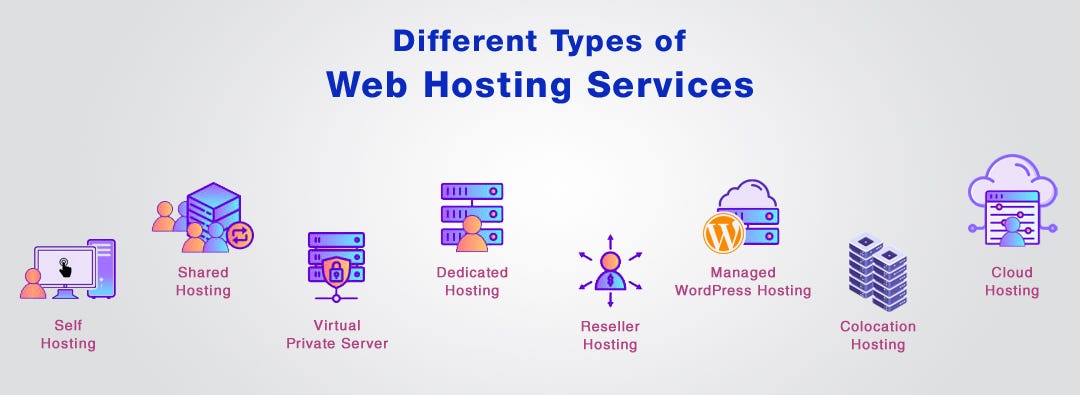
In today’s internet landscape, hosting services can be grouped into four core types, with several advanced variations built on top of them. These are: Hosting Services
- Shared Hosting
- VPS Hosting (Virtual Private Server)
- Dedicated Hosting
- Cloud Hosting
On top of these, there are specialized forms such as managed hosting, WordPress hosting, and reseller hosting. But everything starts from these core categories.
Let’s break each one down in detail so you understand how they work and why they exist.
Shared Hosting: The Beginner-Friendly Starting Point
Shared hosting is the most basic and affordable type of hosting available today. It is designed for beginners who want to launch a website without dealing with technical complexity.
How Shared Hosting Works
In shared hosting, multiple websites are stored on the same physical server. All users share the same resources, including CPU, RAM, and storage. Think of it like living in an apartment building—everyone has their own space, but they share the same infrastructure like water, electricity, and elevators. Hosting Services
Because resources are shared, the hosting provider can offer very low prices. This makes it one of the most popular choices for new website owners.
Why People Choose Shared Hosting
Shared hosting is popular because it is simple, cheap, and beginner-friendly. You don’t need any technical knowledge to use it. Most hosting companies provide a control panel where you can install websites with just a few clicks. Hosting Services
Limitations of Shared Hosting
However, shared hosting also has downsides. Since you are sharing resources with many other websites, performance can drop if another website on the same server gets a lot of traffic. It also offers limited customization and control. Hosting Services
This type of hosting is best for:
- Personal blogs
- Small business websites
- Portfolio sites
- Beginner projects
VPS Hosting: The Balance Between Power and Cost
VPS hosting, or Virtual Private Server hosting, is a step up from shared hosting. It offers more power, flexibility, and control without the high cost of a dedicated server. Hosting Services
How VPS Hosting Works
A physical server is divided into multiple virtual environments using virtualization technology. Each website gets its own dedicated portion of resources. Even though you still share the same physical machine, your environment is isolated from others.
This is similar to owning a private condo in a building—you still share the structure, but your space is fully your own. Hosting Services
Why VPS Hosting Is Popular
VPS hosting is ideal for websites that are growing and need more stability. You get better performance, more control, and the ability to customize your server settings.
It is widely used by: Hosting Services
- Growing businesses
- Developers
- E-commerce websites
- Medium-traffic blogs
Limitations of VPS Hosting
While VPS is powerful, it requires more technical knowledge compared to shared hosting. You may need to manage updates, security, and configurations unless you choose a managed VPS plan. Hosting Services
Dedicated Hosting: Maximum Power and Full Control
Dedicated hosting is the most powerful traditional hosting type. It gives you an entire physical server dedicated solely to your website.
How Dedicated Hosting Works
Unlike shared or VPS hosting, there is no sharing involved. You get full access to all server resources—CPU, RAM, storage, and bandwidth. This means maximum performance and complete control over your environment. Hosting Services
Think of it like owning an entire house instead of renting an apartment.
Why Businesses Use Dedicated Hosting
Large companies and high-traffic websites choose dedicated hosting because it delivers top-level performance and security. It is ideal for websites that cannot afford downtime or slow performance.
Common users include: Hosting Services
- Large corporations
- High-traffic websites
- Gaming servers
- Enterprise applications
Drawbacks of Dedicated Hosting
The biggest downside is cost. Dedicated hosting is expensive and requires technical expertise to manage properly. It is not suitable for beginners.
Cloud Hosting: The Future of Web Hosting
Cloud hosting is one of the fastest-growing hosting technologies in the world. It is flexible, scalable, and highly reliable.
How Cloud Hosting Works
Instead of relying on a single server, cloud hosting uses a network of connected servers. If one server fails or becomes overloaded, another server automatically takes over.
This system ensures high uptime and smooth performance.
Why Cloud Hosting Is Growing So Fast
Cloud hosting has become popular because it solves many traditional hosting problems:
- No single point of failure
- Easy scalability
- Pay-as-you-use pricing
- High performance under heavy traffic
It is widely used by: Hosting Services
- Startups
- SaaS platforms
- Large-scale websites
- Apps with global users
The Biggest Advantage
The biggest advantage of cloud hosting is flexibility. You can increase or decrease resources instantly based on demand.
Specialized Hosting Types
In addition to the main four types, there are several specialized hosting services designed for specific needs.
Managed Hosting
Managed hosting is where the provider handles all technical tasks for you, including updates, security, backups, and optimization. This is perfect for users who want a hands-off experience.
WordPress Hosting
WordPress hosting is optimized specifically for WordPress websites. It includes pre-installed WordPress, enhanced security, and faster performance for WordPress sites.
Reseller Hosting
Reseller hosting allows you to start your own hosting business by selling hosting services to others. You don’t own servers—you rent and resell hosting space.
Comparison of Hosting Types
| Hosting Type | Cost | Performance | Control | Best For |
|---|---|---|---|---|
| Shared Hosting | Low | Basic | Low | Beginners |
| VPS Hosting | Medium | Good | Medium | Growing websites |
| Dedicated Hosting | High | Excellent | Full | Enterprises |
| Cloud Hosting | Flexible | Excellent | Medium | Scalable projects |
How to Choose the Right Hosting Type
Choosing the right hosting depends on your needs, budget, and experience level. Here is a simple breakdown:
- If you are a beginner → Shared Hosting
- If your site is growing → VPS Hosting
- If you need power and security → Dedicated Hosting
- If you want flexibility → Cloud Hosting
Always think long-term. Your website may grow, so choose a hosting type that allows easy upgrades.
Future of Hosting Services
The future of hosting is moving toward automation, artificial intelligence, and cloud-based systems. Hosting providers are now using AI to optimize performance, detect threats, and manage resources automatically.
We are also seeing a shift toward:
- Edge computing
- Serverless hosting
- Fully automated cloud systems
In the coming years, hosting will become even faster, smarter, and easier to manage.
FAQs
1. What is the most common type of hosting?
The most widely used type of hosting in the world today is shared hosting, and this is mainly because it is affordable, simple, and designed for beginners. In shared hosting, many websites are hosted on a single server and they all share the same resources such as CPU, RAM, and storage. This setup allows hosting companies to reduce costs significantly, which is why they can offer very cheap plans to customers.
Shared hosting is especially popular among individuals who are just starting their online journey. For example, bloggers, students, small business owners, and personal portfolio creators often choose shared hosting because it does not require any technical knowledge. Everything is managed by the hosting provider, including server maintenance, security updates, and performance optimization.
Another reason shared hosting is so common is that most small websites do not need advanced resources at the beginning. A new website usually has low traffic, so sharing resources with other websites is not a problem. However, as traffic grows, users often upgrade to more powerful hosting types like VPS or cloud hosting.
In simple terms, shared hosting is the “entry-level” option of the hosting world. It is like renting a small room in a shared building—it gives you everything you need to get started without high costs or complexity.
2. Which hosting type is best overall?
There is no single “best” hosting type for everyone because the ideal choice depends entirely on your needs, goals, and budget. However, in terms of overall flexibility and performance, cloud hosting is often considered the strongest option in 2026.
Cloud hosting stands out because it uses multiple servers connected together instead of relying on just one machine. This means if one server fails or becomes overloaded, another server automatically takes over. As a result, websites hosted on the cloud experience higher uptime, better speed, and improved stability.
Cloud hosting is also highly scalable. If your website suddenly receives a spike in traffic—such as during a marketing campaign or viral content—you can instantly increase your resources without downtime. This makes it ideal for growing businesses, e-commerce platforms, and applications with unpredictable traffic.
On the other hand, VPS hosting is often considered the best “balanced” option. It offers a middle ground between affordability and performance. You get dedicated resources within a shared environment, which makes it more stable than shared hosting but less expensive than dedicated hosting.
So, the answer depends on your situation:
- Beginners → Shared Hosting
- Growing websites → VPS Hosting
- Scalable businesses → Cloud Hosting
- High-performance enterprises → Dedicated Hosting
The “best” hosting is the one that matches your current needs while allowing future growth.
3. Is dedicated hosting necessary for small websites?
No, dedicated hosting is not necessary for small websites, and in most cases, it is not the right choice at all. Dedicated hosting provides an entire physical server exclusively for one website, which means it offers maximum performance, security, and control. However, this level of power is usually far beyond what small websites actually need.
Small websites such as personal blogs, portfolios, or local business pages typically receive low to moderate traffic. These websites do not require massive server resources, so paying for a full dedicated server would be unnecessary and expensive. It would be like renting an entire stadium just to host a small private meeting.
Dedicated hosting is best suited for large-scale operations such as:
- High-traffic e-commerce websites
- Large corporate systems
- Gaming servers
- Applications with millions of users
For small websites, more affordable options like shared hosting or VPS hosting are much more practical. They provide enough resources to run smoothly without wasting money on unused capacity.
However, it is important to note that small websites can grow over time. That is why many hosting providers allow easy upgrades from shared hosting to VPS or cloud hosting when needed. This flexibility ensures that users only pay for what they need at each stage of growth.
4. What is the easiest hosting type to use?
The easiest hosting types to use are shared hosting and managed hosting, especially for beginners who have no technical background.
Shared hosting is designed to be extremely user-friendly. Hosting companies handle all the complex technical work behind the scenes, including server maintenance, software updates, and security management. Users are provided with simple control panels like cPanel or custom dashboards where they can manage their websites with just a few clicks. You don’t need coding knowledge or server experience to get started.
Managed hosting takes ease of use even further. In managed hosting, the provider handles almost everything for you. This includes performance optimization, daily backups, security monitoring, updates, and sometimes even content optimization. This makes it ideal for people who want to focus only on running their website without worrying about technical details.
For example, a blogger or business owner using managed WordPress hosting can simply focus on creating content while the hosting provider ensures that the website runs smoothly, loads fast, and stays secure.
In short:
- Shared hosting = Easy setup + basic control
- Managed hosting = Fully hands-off experience
Both options are perfect for beginners, but managed hosting is the most convenient for users who want zero technical involvement.
5. Can I upgrade my hosting later?
Yes, absolutely. One of the biggest advantages of modern hosting services is that they are designed to be scalable, which means you can upgrade your hosting plan as your website grows.
Most hosting providers allow you to start with a basic plan, such as shared hosting, and then upgrade to more advanced options like VPS, cloud hosting, or dedicated servers when needed. This process is usually smooth and does not require rebuilding your website from scratch.
For example:
- If your blog starts getting more visitors than expected, you can upgrade to VPS hosting for better performance.
- If your business grows rapidly and traffic becomes unpredictable, you can move to cloud hosting for automatic scalability.
- If you need maximum power and security, you can switch to dedicated hosting.
The upgrade process is usually handled by the hosting provider, meaning your website stays online during the transition or experiences very minimal downtime. This flexibility is one of the reasons why web hosting is so powerful in today’s digital world.
It’s important to choose a provider that offers easy upgrade paths. This ensures that your website can grow without limitations or technical barriers. In other words, you don’t need to worry about choosing the “perfect” hosting from the start—you can always upgrade as your needs evolve.
Conclusion
So, how many types of hosting services are there in 2026?
The answer is that there are four main types of hosting services—Shared, VPS, Dedicated, and Cloud hosting—plus several specialized variations like managed, WordPress, and reseller hosting.
Each type serves a different purpose, from simple personal websites to large-scale enterprise systems. Understanding these hosting types helps you choose the right foundation for your online success.
In the end, the best hosting is not the most expensive one—it is the one that fits your needs perfectly.